Water pollution affects your well water and living things around your home that rely on clean water to survive. You can take simple steps around the house that will help protect the water resources for you and your community.
Directing downspouts and sump pump discharges to areas planted with water-loving plants, called rain gardens, helps water filter through the soil and recharges groundwater. University of Maine Cooperative Extension has a very good fact sheet online about installing rain gardens; click here to view it.
Mowing your lawn higher than 3 inches will produce a lush turf that holds water, is weed-resistant, and requires less fertilizer.
Maintain lush native plant growth in areas with steep slopes to hold soil in place. When you seed areas, use straw mulch to minimize erosion.
Slope driveways and patios to direct rainwater and snow melt to vegetated areas that recharge groundwater. When planning for additions or renovations, be sure to leave plenty of room to direct stormwater.
Planting native plants reduces need for chemical pesticides and fertilizers because these plants are well suited for the environment of New Hampshire. Furthermore, native plants provide food and habitat for many wildlife species. Hardy native plants include white pine, arrowwood viburnum, and winterberry.
Build the smallest buildings, patios, and driveways possible and use water-permeable materials when you can.
Grow and maintain plants that require no fertilization. Reduce lawn area and use only slow release fertilizers.
The New Hampshire Department of Environmental Services recommends that septic systems be inspected annually and pumped every three to five years. Never send grease, toxic chemicals, pharmaceuticals, or nonbiodegradable materials down the drain. These materials cause can thousands of dollars worth of damage.
Maintaining 100 feet of lush, vegetated areas adjacent to wetlands will filter stormwater runoff, reduce erosion, lessen impacts of flooding, and provide adequate habitat for many wildlife species.
*Sources Environmental Defense Fund, US Environmental Protection Agency, National Recycling Coalition
The FedCenter has compiled a topical index of Federally-sponsored and non-profit mobile applications that may be of interest to the Federal environmental community. Mobile applications are those tools and information resources that have been specifically developed for your mobile devices, such as smartphone, tablet, or other Internet-connected hand-held device. The directory will be maintained daily to keep you abreast of any new and useful mobile applications the federal community releases. For more information on the directory, click here.
(Note: FedCenter membership not required, fees may apply)
Southeast Land Trust: The Southeast Land Trust has a goal to conserve the significant lands and natural resources of greater Rockingham County, including farmland, working forests, water, wildlife habitat and natural areas, and community landscapes.
Rockingham County Conservation District: The District works with landowners and users, local government agencies, and other local interests in addressing a broad spectrum of resource concerns. These concerns include but are not limited to surface and ground water quality and quantity, nonpoint source pollution, erosion and sedimentation, stormwater, flooding, wetlands, forestlands, wildlife habitats, and solid waste. Conservation Programs in Rockingham County are carried out through public education and the implementation of Best Management Practices (BMPs). Technical assistance and information for the implementation of BMPs are provided for various land uses in cooperation with the Natural Resources Conservation Service (NRCS), other state and federal agencies and organizations, District staff and volunteers, and district consultants.
Exeter Area Garden Club: The objective of EAGC is to encourage interest in all phases of home gardening and to promote civic beauty and conservation of natural resources.
State of NH Department of Environmental Services: The mission of the New Hampshire Department of Environmental Services is to help sustain a high quality of life for all citizens by protecting and restoring the environment and public health in New Hampshire. This site provided form, applications, permitting information, lab services, public information, publications and related RSA links.
The NH ENERGY STAR homes program encourages customers to take advantage of the benefits of building a new (or complete renovation of an existing) single or multi-family energy efficient home with incentives up to $3,000. ENERGY STAR construction results in reduced monthly operating costs, improved homeowner comfort and a higher resale value, all while providing greater environmental benefits. The program provides assistance in evaluating your new home plans, air leakage testing, and incentives to install ENERGY STAR appliances and lighting systems.
Compost bins and rain barrels will not be available for 2019. Please contact Conservation Commission member Bill Kenny if you would like to be added to the list to purchase a bin or barrel next year. Thank you.
If you would like a map of Trails of Stratham Hill Park and the surrounding forest lands, one is available thru the Stratham Recreation Commission at the Stratham Town office.
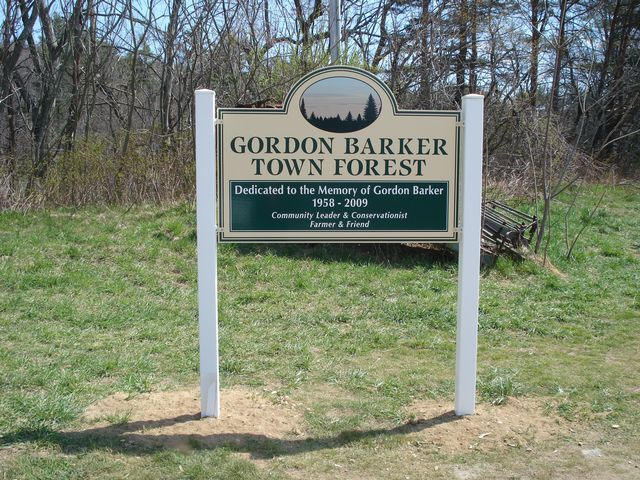
2009 was a sad year for the Barker family, the Town of Stratham, and the Conservation Commission. During this year, we lost Gordon Barker, lifetime resident of Stratham, owner of Barker's Farm and one of the longest standing members on the Commission who was dedicated to protecting the natural resources in town.
Gordon was taking action to protect land long before it was recognized as an important thing to do. He was a Selectman at the time the Gifford property became available with fields, forest and wetlands. A special town meeting was held to ask the Town to purchase the property. Gordon was instrumental in raising awareness of the value of that land for the Town.
A portion of this property was ultimately used to build the Stratham Memorial Elementary School. A portion was used to complement Stratham Hill Park for recreational activities. In 1994, The Town Forest was established to be managed by the Conservation Commission. The forest is about 84.5 acres and primarily lies northwest of the school and southeast of the Park. It has a wide diversity of soils and the forest is composed of diverse species including white and red pine, several kinds of oak, maple and hickory, and Atlantic White Cedar that is somewhat rare in this state. The diversity of soils and the variety of acorn and nut producing trees provide for a variety of food sources for nearly 80 different species of birds and mammals that make their home in and around the forest.
The forest has a number of trails that are used daily in the warmer months by dog walkers, hikers and runners, and in snow by cross-country skiers. Stratham Memorial School takes advantage of its proximity to the forest and often brings kids out for educational experiences in the woods and ponds.
In the years since this property was purchased, thousands of people both from Stratham and its surrounding communities have had the opportunity to enjoy the beauty of the forest, and for that, we have Gordon to thank.
In 2010, the Town of Stratham voted unanimously to rename the Town Forest the "Gordon Barker Town Forest" in honor of his memory and in recognition of his many years of service to the Town of Stratham. We hope you visit the town forest often and silently thank the Gordon, the person who made it possible to enjoy forever.
The new wetlands permit application form, a single permit application form, replaces the expedited review minimum impact, standard review minimum impact and standard review minor or major impact forms.
Last year, Land Resources Management (LRM), a new subsection of the Water Division, began integrating those bureaus and permit programs that regulate land development projects that impact aquatic resources. Land Resources Management includes the Alteration of Terrain Bureau, Drinking Water and Groundwater Bureau, Subsurface Systems Bureau, Wetlands Bureau and the Shoreland Program. The main objective of this integration is to create a more cost effective, efficient process amongst these programs that provides a more streamlined permitting process for the regulated public and better achieves DES' overall mission of protecting and restoring the environment.
One of the first pieces implemented by LRM last year was the establishment of a new coordinated application receipt center (ARC). The ARC is composed of cross-trained, administrative staff that performs a precursory review of most incoming permit applications to ensure at least the minimum elements are present before DES begins technical review. Application packages received containing all required elements are accepted and applicants are mailed a "letter of acceptance" and applicants that submit application packages missing required elements are mailed a "notice of administrative incompleteness" that identifies all missing elements and the complete permit application package, including the fee, is returned.
Since the ARC was first established, it has been patiently accepting multiple versions of permit application forms - even outdated application forms that were created well over ten years ago! In order to continue creating a more streamlined permitting process that better serves the regulated public, Land Resources Management will no longer be accepting outdated permit application forms. Effective April 1, 2012, except the Drinking Water and Ground Water Bureau, all LRM permit application forms received must have a revision date, located within the footnote, of 01/01/2012. Going forward, all LRM program permit application forms will be simultaneously updated every six months. The next scheduled update will occur on July 1, 2012.
Today, all updated permit application forms are available on their respective web pages and each form clearly identifies all critical elements required in order for the permit application to be accepted by the application receipt center (ARC). For more information on NH DES Land Resource Management, please click here to visit their website, or click here to email Jay Aube, Shoreland Program Outreach Program Outreach Coordinator.
In its simplest definition, open space is land that has not been developed or converted to other uses. It includes forests, fields, river corridors, wetlands, wildlife habitat, and greenway corridors, as well as agricultural lands and town parks. These are features that make Stratham a special place to live.
Open space is a very important part of any community. It is an investment in the rural character of our community. Open space yields more in tax revenues than it costs in town services. It provides aesthetic and scenic values, wildlife habitat, recreational opportunities, and helps to ensure our water supply protect the health of streams and minimize urban sprawl. Recreational opportunities on open land include walking, hunting, fishing, biking, wildlife viewing, and photography, just to name a few. Stratham residents understand that open land will not remain open in perpetuity unless protected.
In 1999, the town voted to put tax money that the town collects when a property is taken out of Current Use into the Land Conservation Fund. Previously, this fund only received $10,000 per year and little was able to be done with the fund. At the March 2002 Town Meeting voters approved $5 million bond for the purpose the Town to acquire conservation easements or open space lands. The bond was the largest in the state and was approved by the largest margin with 88% of voters approving the article.
The bond fund was not intended be used to purchase commercially zoned land, although small areas may be included if they are adjacent to larger agricultural parcels. With the creation of the conservation bond fund, the Town of Stratham had the financial readiness to act quickly when a desirable parcel of land became available for sale or for conservation easement. Moreover, the bond find provided landowners, who were considering selling their property for development, a conservation-minded option. This provided income to property owners who have equity in the land they own, while also allowing them to retain ownership and permanently protect open space.
In 2002, the Conservation Commission appointed an Ad Hoc Bond Subcommittee to develop criteria for land selection, to compile a list of potential properties for conservation and to assist landowners with the process of appraisals and easement development. The initiative incorporated a public hearing process which allowed for public input on the easement purchase process, with final decision making being left to the Board of Selectmen. The Commission and the Ad Hoc Committee agreed that some of the key criteria for purchase of a parcel would consider the following: whether or not parcels are in the Aquifer Protection District, have important wildlife corridors and/or viewsheds, if they protect farmland, and whether or not they are adjacent to other easement properties or town owned lands.
The Town of Stratham and its abutting communities continue to experience tremendous growth in housing development. The Commission and the community believed it was important to protect some open space areas, to allow residents to continue to relate to the desirable qualities that originally attracted them to the Town. One of the essential reasons to plan for open space was to set a course of coordinated development for the Town that maintained the Town's high quality of life. Many times decisions are made on land use without the benefit of a unifying plan to coordinate the actions. The result is haphazard development that disregards the Town's and/or region's unique characteristics and sense of place.
It is the policy of the Town of Stratham, under the Master Plan, to protect Stratham's natural resources, agricultural land and other open spaces by securing the development rights to important open space and conservation lands. Prior to the open space bond initiative purchase, the Town had already had 1000 acres of conservation and restricted development land in Stratham.
In 2012, the Town had expended the $5 million bonding limit, along with an additional $2 million in grant funding to preserve a total of 543.3 acres in perpetuity – almost 6% of the land area in Stratham. Each project was closed after conservation easements were drafted, and appraisals, surveys and title searches completed. Each project, before receiving final approval, faced its own public hearing at which members of the Ad Hoc Committee and Conservation Commission outlined the merits of the property and the benefit to the taxpayer and answered specific questions from Selectmen and the public.
A conservation easement is a legally binding agreement between a landowner and a conservation organization or agency and, because it is recorded in the county Registry of Deeds a conservation easement is part of the permanent public record; future lenders and owners are therefore made aware of it and its restrictions. A conservation easement permanently restricts future development of a property. Each easement is tailored to protect important and specific values of the land.
Each property protected held development potential. Together, the 543 acres would have supported the development of many dozens of homes that would require roads and infrastructure to support the new residential construction.
Partners assisting and cooperating with the Town include the Rockingham County Conservation District and the Southeast Land Trust, a local New Hampshire non-profit. With few exceptions these two organizations hold the easements and the Town of Stratham holds executory interest. This means that these organizations are responsible for the long term monitoring and enforcement of the terms of the easements.
Town staff, Selectmen and Planning Board volunteers contributed a great deal of time and expertise. State and federal agencies also partnered with the Town by contributing matching funds totaling $2,086,072.00, which stretched our bond significantly further. Over the past 10 years, our most important partners have consistently proved to be the participating Stratham landowners, those who for different, sometimes very personal, reasons desired to conserve their property, forego their rights to develop their land and were willing to work with the Town in a process that took months (and in some cases several tries and several years) to complete. Land conservation to this extent in a local community would not be possible without willing landowners.
In gratitude to our partners and to the citizens of Stratham, all essential to the final outcomes, here is a brief description of the lands and scenic, wildlife, water, and farm and forest resources protected since the bond was passed by Stratham citizens on March 15, 2002:
This entire effort was started by a small group of residents who came before the Conservation Commission with a proposal: they wanted to help preserve land in town and would work to achieve that goal. Fueled by the knowledge that other NH towns had funded major land conservation initiatives, the Conservation Commission decided in 2001 to embark on a major campaign to permanently protect 750 acres, roughly 1/3 of our remaining buildable land. With the Commission's support, a core group of about a dozen residents got to work and named the campaign Stratham, Our Town and committed to asking voters at Town Meeting to approve a $5 million bond to be paid back over 15 years. Below are links to the 5 newsletters sent to residents to prepare them for the vote in March of 2002 as well as the Case Study. We are so proud that the bill passed with an 88% YES, and are offering the following materials as a basis for other communities to pursue their own conservation efforts.