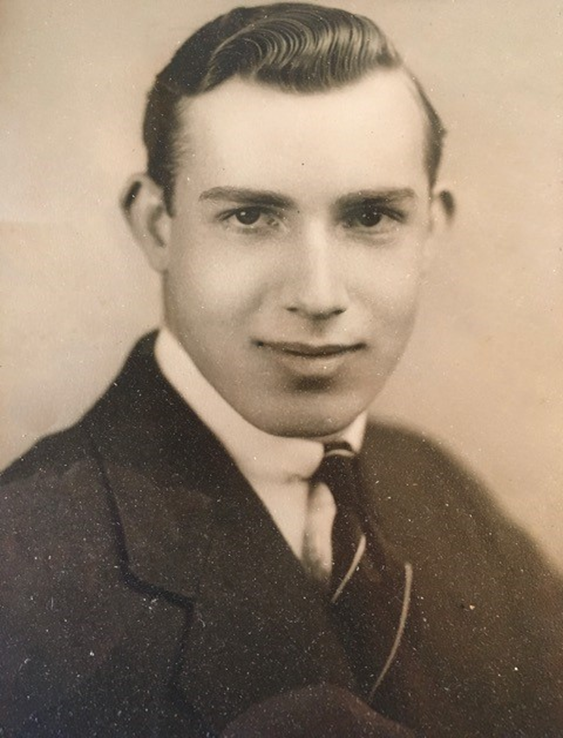
Say hello to Winfield L. Foote (1922-2004). He was the only child of Leah (Cottrell) and Harry Foote. The Stratham house and property where Winfield grew up at 154 Portsmouth Avenue was sold by the First Christian Society to Leah Foote “in consideration of one dollar” in 1930. The house earlier served as the parsonage of the adjacent Christian Church. Leah and Harry are pictured in the driveway. Today the property below is known as Winfield Foote House Antiques.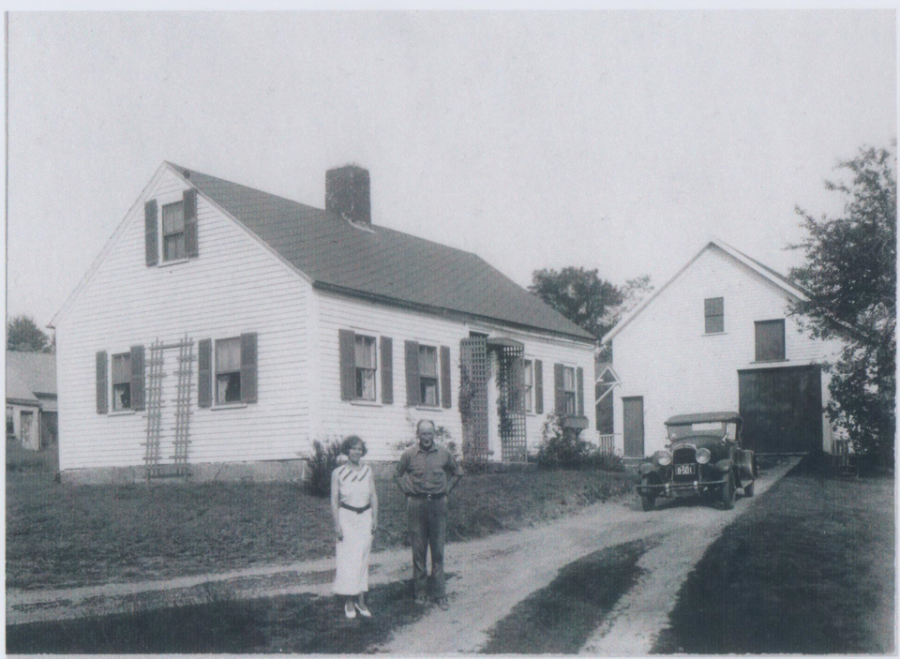
Winfield was one of fifteen students in the one-room Ridge School on Portsmouth Avenue. Pictured below, third from the left in the front row, is Winfield at age 10 when he was attended by Miss Edna M. Crane in 1932.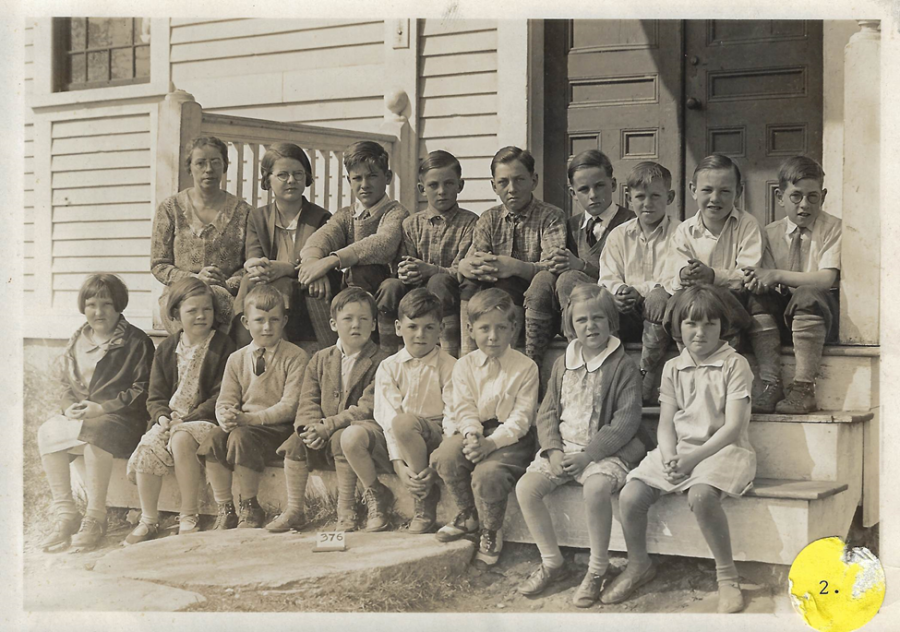
In the undated interior Ridge School photo below Winfield is seated at the far right. He graduated from Exeter High School in 1940.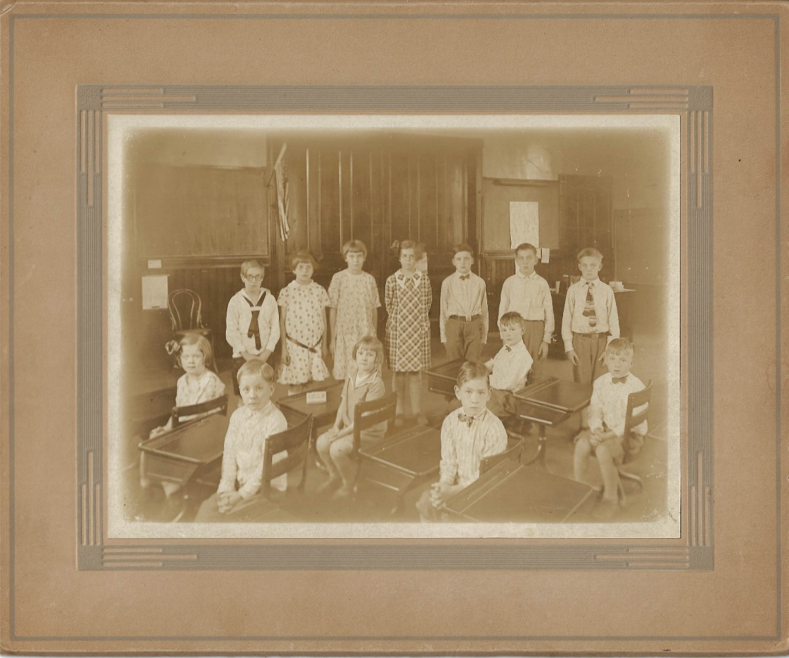
Winfield worked locally and lived his entire life in the former parsonage his mother bought for $1. He was employed in Newmarket by United Technologies and by the Smith Shoe Company. Like so many Stratham residents, he also worked at the Portsmouth Naval Shipyard.
Winfield never married and had no children. In the early 1990s, he was known to occasionally pop into the neighboring Stratham Historical Society at 158 Portsmouth Avenue to visit with then President Barbara Mann. Barbara was grateful for his visits where she could share her passion for Stratham history and she welcomed Winfield warmly.
Upon his passing in 2004, officers of the Society were shocked to learn that Winfield had left his house and personal property to the Stratham Historical Society. Working to construct a path for the highest and best use for this unusual and remarkably generous bequest, SHS officers and members met repeatedly to agree that the house and property should be sold to create a perpetual risk-free investment from which 80% of the earnings annually would fund scholarships to deserving college age students and would fund grants to projects that are consistent with the mission of the Stratham Historical Society. 10% of annual earnings would and continue to go to SHS for operating expenses while the remaining 10% would always be kept in the endowment to grow its principal. At the beginning of July, the Stratham Historical Society named ten local winners of the Winfield L. Foote Award of Excellence. They each received $1,500 toward their 2026-2027 college tuition. We think that Winfield and even Miss Crane would rejoice to know that Winfield’s gift has distributed over $165,000 in scholarships and grants since inception while the endowment principal has grown by over 13%.
Faces of Stratham are provided by the Stratham Historical Society. The SHS Museum & Library are currently open on Tuesdays from 9 to 11:30 am or by appointment. Anyone with an interest in Stratham and local history is invited to stop by, become a member, donate and/or volunteer. We are actively seeking to expand membership and identify those with an interest in volunteering time. We can best be contacted by emailing info@strathamhistsoc.org.
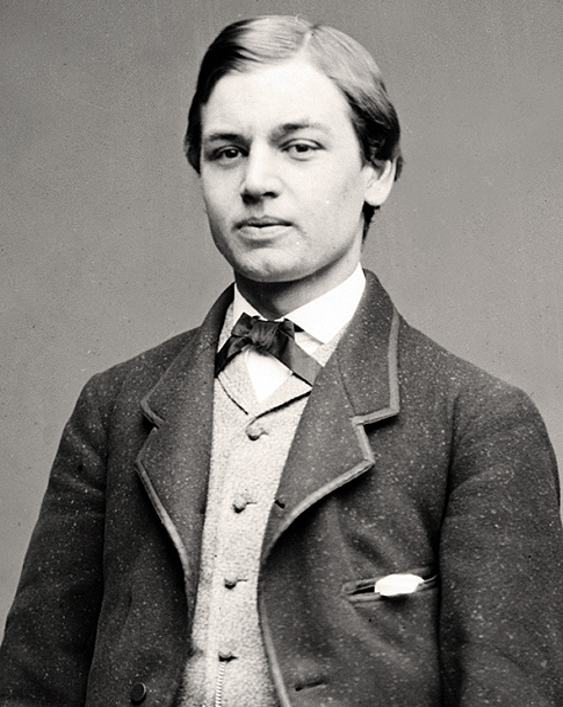
Robert Todd Lincoln ca. 1860
This is the face of Robert Todd Lincoln (1843-1926). Not a face or name that one normally associates with Stratham. Robert, aka Bob, was the eldest son of Abraham and Mary Todd Lincoln (1818-1882). He served our country briefly as a soldier at the end of the Civil War and later as U.S. Ambassador to the United Kingdom and U.S. Secretary of War.
 |
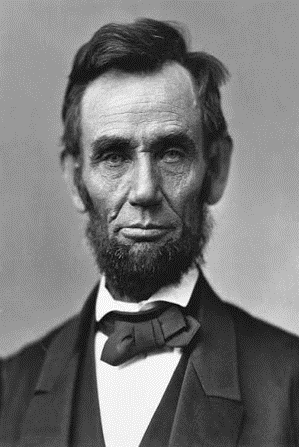 |
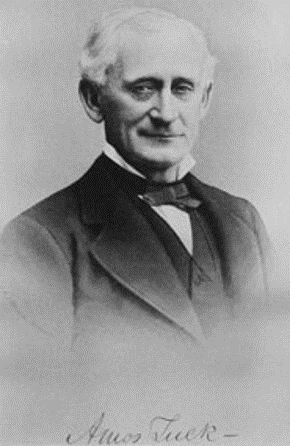
Here is the back story on Bob's link to Stratham. Abe Lincoln (1809-1865) was elected as a Whig to the U.S. House of Representatives in 1847. When he arrived to take a seat in the House, the lone remaining seat placed him near the back of the hall next to Amos Tuck (1810-1879). Tuck lived on Front Street in Exeter across from what is now the Exeter Inn. He also had a prominent Exeter law firm. Amos and Abe quickly bonded. Their political and personal friendship ultimately led to Abe's presidential election and the founding of the Republican Party.
Abe and his father-in-law were lawyers, so there was little doubt that Bob's future was shaped before birth. Bob struggled mightily with his entrance exams to Harvard. It was decided that he would take a prep year at Phillips Exeter Academy starting in the fall of 1859. It's fair to conclude that Abe's relationship with Amos influenced the Exeter game plan. The PEA strategy paid dividends as Robert Todd Lincoln attended Harvard the following year and ultimately graduated with a law degree.
Boston-born Frank Fuller was a governor of Utah, lawyer, physician, friend of Mark Twain and acquaintance of Abe Lincoln. While practicing as a dentist on Congress Street in Portsmouth, he began making speeches for the Republican party and became known as a politician and local public figure. Dr. Fuller was asked to speak at Stratham’s July 4th celebration in 1860. He thought it would be strategically advantageous to have Robert Todd Lincoln read the Declaration of Independence if his father would agree. Abe responded by saying “Tell Robert to take every occasion to read the immortal document and the bigger the crowd the louder he must holler”.
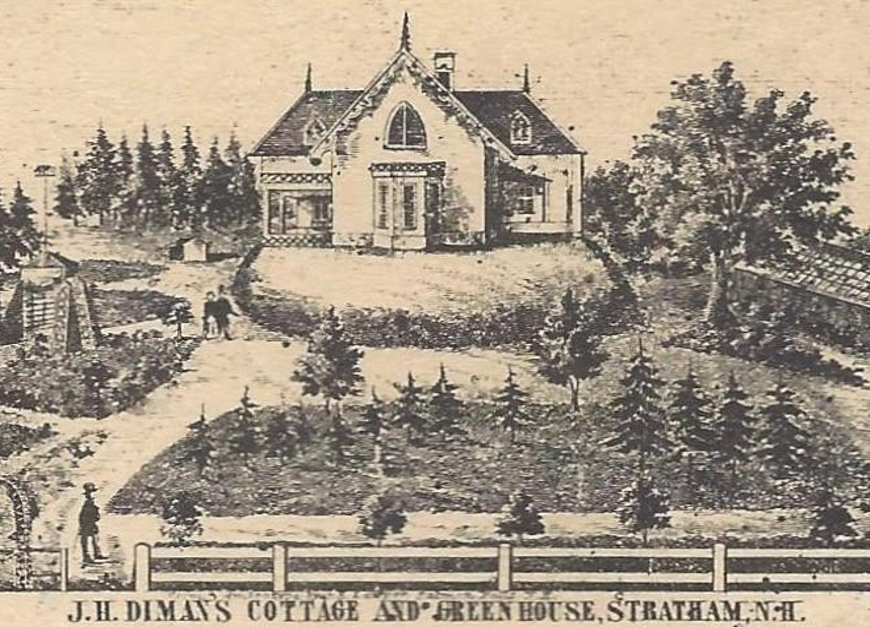
With permission, on July 4, 1860, Bob attended a Strawberries and Cream Party at the cottage and greenhouse of James Diman. The Diman property was set back off Depot Road near the intersection of Sandy Point Road. Strawberries and Cream Parties were a favorite tradition of Mary Todd Lincoln who was once photographed by Matthew Brady in a strawberries dress. 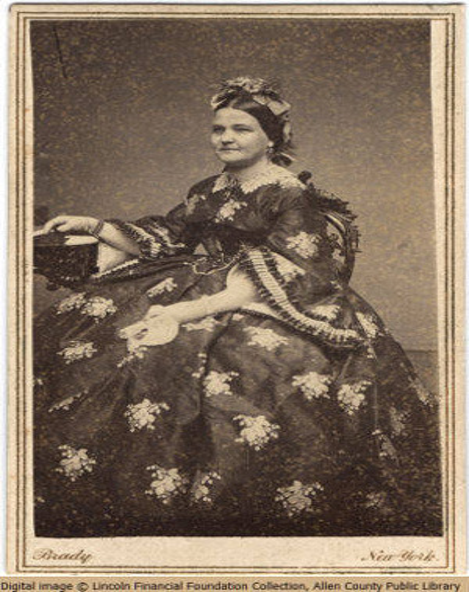 Mary Todd Lincoln ca. 1861-1862
Following strawberries and cream, the guests hosted by James Diman marched up Sandy Point Road to enter what would later become known as Stratham Hill Park. The group then worked its way half the distance to the top of the hill whereupon Bob stood perched on a boulder and read aloud the Declaration of Independence, a document published on July 4th in 1776 that established the foundational principle that all people possess fundamental rights. Today, a brass plaque commemorates the historic site and occasion.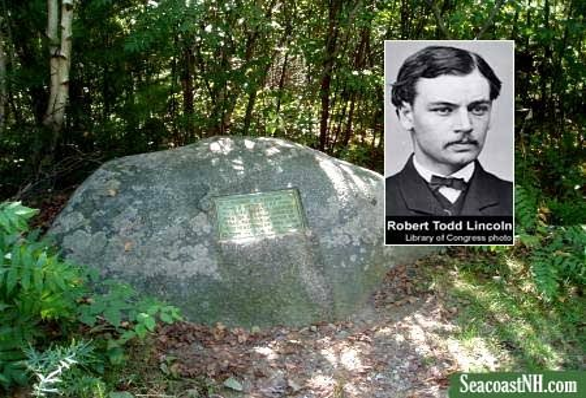
Faces of Stratham are provided by the Stratham Historical Society. The SHS Museum & Library is currently open on Tuesdays from 9 to 11:30 am or by appointment. Anyone with an interest in Stratham and local history is invited to stop by, become a member, donate and/or volunteer. We are actively seeking to expand membership and identify those with an interest in volunteering time. We can best be contacted by emailing info@strathamhistsoc.org.
George Edward Gowen (1846-1917)
Stratham was first visited in 1631 and settled in 1633 with the intent to expand the English fisheries and farming that were started at Hilton Point in Dover. It wasn’t long after that early settlers learned of the fertile planting grounds that existed in Stratham, then known as the Squamscott Patent. Deeds of 60-80 acres often came with an area of salt marsh and/or meadows that yielded hay, feed and other natural planting opportunities. Long before the days of specialization by dairymen, poultry men and orchardists, farms were diversified. They grew and bred whatever it took to keep the farm and family going.
The evolution of farming was driven by customer demand. Skipping ahead to the mid-19th century, Stratham gave birth to a generation of Market Gardeners. Market Gardeners were characterized by smaller farms that remained product and demand diverse. They were often operated by families where everyone played a role and where local laborers might be added to round out the workforce. Nearly all Market Gardeners had a roadside stand, particularly if they were on a heavily trafficked roadway. Barker’s Farm, Rawson’s Farm and Wake Robin Farm would be considered today’s examples of Market Gardeners. Just about everyone could find and buy something of value from Stratham’s Market Gardeners. The most sophisticated and productive Market Gardeners had wagons and vehicles to move their products through the likes of Exeter, Portsmouth and Amesbury.
Direct to costumer sales drove the market gardening concept that is believed to have begun in Stratham by John Emery around 1850. John’s farm stand on Emery Lane next to the former Chase’s Tavern (then owned and occupied by the Emerys) was highly visible to all on the road between Portsmouth and Exeter. This site was made even more popular when John’s son, John Fred or J. Fred Emery took over the business. Fred Emery was active in the nearby church and active in the community as a Selectman. He served on many committees and was the Town Tax Collector. He was prominent in the Order of Red Men. Fred was a poet and well-known raconteur. Ed Rawson learned the game when, at age 10, when he picked fruit and vegetables from the smallish parcel behind the Emery house to bring up to Fred’s roadside farm stand.
Richard Montgomery Scammon published “A Sketch of Stratham” in the March, 1899 issue of Granite Monthly wherein he mentioned that “market gardeners were among Stratham’s most active citizens” and they had grown to include “W.H. Lang, W.G. Roberts, George W. Dixon, the Chapman Brothers, W. Marsh, John S. Scammon, F.H. Pearson, William Roby and others”. While George E. Gowen did not appear on this list, both Scammon and Charles Nelson in his History of Stratham, New Hampshire penned that “George E. Gowen is one of our foremost market gardeners. In addition to his field operations he has a large area under glass in his greenhouse and hot beds.” Both authors noted that Gowen seasonally employed fifteen or twenty hands to evaporate apples.
By now you’ve noticed that all of the images in this article highlight George Edward Gowen. George never grew anything by accident, and it is no accident that this article celebrates the accomplishments of George E. Gowen as one of our leading Market Gardeners. He was an educated man with a scientific approach. Scammon wrote that Gowen “is a diligent student of the business and is a recognized in every branch”.
George bought 70 acres of Ezra Barker land on High Street bordering Heathy Swamp and the considerable Barker Farm in 1877. He built his house and carriage barn by 1900. His ninth child and seventh son Benjamin Francis Gowen bought the connecting High Street property to the north. Together, they employed family members from Stratham and Greenland as well as local residents to make their combined farms as productive as possible. George Edward Gowen was a scientist, an educator, an accomplished farmer at Hillside Farm, a successful entrepreneur, an enviable Market Gardener and a credit to the Town of Stratham. His family populated Stratham’s baseball team when it faced Newmarket, Hedding and other local teams. Turn of the 20th century Gowens who were not in uniform on game day often served as manager, scorekeeper and/or umpire. When they weren’t evaporating apples, they were fielding grounders at the park. And the family was not shy about taking over Stratham Hill Park for a 1932 family reunion. According to Iris Gowen, “there is a George Gowen in each generation up to mine, and most of them are George Edward”. How many George Edward Gowens do you imagine may be pictured below?
Faces of Stratham are brought to you by the Stratham Historical Society. We thank Iris Gowen for providing valuable photos and input with respect to the content in this article. The Stratham Historical Society Museum & Library is now open on Tuesdays from 9 am to 11:30 am or by appointment. We hope to expand our open hours in the coming months. Anyone with an interest in Stratham and local history is invited to stop by, become a member, donate or volunteer. We are actively seeking to expand membership and identify those with an interest in volunteering time to advance and share their learning of Stratham history. We can best be contacted by preferably emailing info@strathamhistsoc.org .
In December, “Faces of Stratham” introduced you to Richard Montgomery Scammon (1859-1914), one of Stratham’s most prestigious residents from one of Stratham’s oldest and most prestigious families. He was Town Treasurer, Superintendent of Schools, Town Moderator and elected to chair the Select Board. He served in the State Legislature and was elected to the State Senate. With all of his public service, he still found time to pen an article that was published in the March, 1899 issue of the widely read The Granite Monthly. His article “Down the King’s Great Highway, A Sketch of Stratham” was the fully disclosed basis of Charles Nelson’s History of Stratham, New Hampshire 1631-1900. In the December “Faces of Stratham”, we hinted we would introduce you to Richard’s wife, the equally dynamic Annie Prentiss Wiggin Scammon (1872-1962).
Annie Wiggin Scammon, as she became well known, was a daughter of Stratham and the daughter of George Alfred Wiggin (1848-1903) who directly descended from Stratham’s first settler and colonial governor Captain Thomas Wiggin. Annie grew up in a house that still stands on Depot Road. Her mother was George’s first wife Isabel “Bell” P. Tucker (1851-1880) of Nottingham. Most likely, Annie’s education started in Stratham’s one-room Stratham Hill School on Portsmouth Avenue. Annie graduated Mount Holyoke College and taught high school in Portland, Maine. She married Richard Montgomery Scammon in 1897 and later shared his interest in town affairs as a Stratham town officer on the Board of Education.
Annie Prentice Wiggin married Richard Montgomery Scammon in1897 and shared his interest in town affairs, serving as a Town Officer on the Board of Education. Richard passed away in 1914 at the age of 55, leaving Annie to manage their 250-acre farm on River Road. The farm grew fruit and vegetables and kept cows and horses. She collaborated closely with farm manager Fritz Olson and others to continue the farm’s productive legacy through the 1950s. Annie took on a long-term Miss Edna Crane (1890-1964) as a long-term lodger. Many town residents may recall Miss Crane as a schoolteacher and the Stratham Memorial School’s first principal.
As you may have noticed in the Town Report above, Annie W. Scammon also found herself to be a Library Trustee. In fact, she is Stratham’s longest serving Library Trustee. Superintendent of Stratham Schools George A. Wiggin died in 1903. His will named Annie a permanent Library Trustee, though it is not perfectly clear how he had standing and how such a wish could have been honored in the year of his death. His second wife, schoolteacher Emma Blodgett Wiggin (1852-1909), passed in 1909. The estate that Emma inherited allowed her to bequeath $10,000 for the “purchase of a suitable lot on the main road near the village in Stratham, in some elevated site, convenient of access,” and to “erect thereon a library building of … brick or stone”. Emma was known to be critical of the construction quality of wooden schoolhouses. Emma wrote her bequest was “given by me in memory of my late husband and in accordance with what I know to be his expressed desire for the welfare of his native town and its citizens”. The first dedicated public library building in Stratham opened its doors in July of 1912. The landmark stone building was then known as the George A. and Emma B. Wiggin Public Library. The listing of Library Trustees from 1911 through 1916 was a bit uneven, but from 1917 until her passing, Annie Wiggin Scammon clearly served the people of Stratham as Library Trustee.
Annie Wiggin Scammon died just days after her 90th birthday on August 10, 1962. She passed 48 years after the death of Richard Montgomery Scammon. Without having any children, their historic property was bequeathed to the heirs of Richard’s brother who lived in the Midwest. In 2023, the Scammon farm homestead and family cemetery, as well as two adjacent properties, gained listing on the National Register of Historic Places.
Faces of Stratham are brought to you by the Stratham Historical Society. We thank Scammon family descendant Jeff Hyland and Donna Jensen for providing valuable input with respect to the content in this article. The Stratham Historical Society Museum & Library is now open on Tuesdays from 9 am to 11:30 am or by appointment. We hope to expand our open hours in the coming months. Anyone with an interest in Stratham and local history is invited to stop by, become a member, donate or volunteer. We are actively seeking to expand membership and identify those with an interest in volunteering time to advance and share their learning of Stratham history. We can best be contacted by preferably emailing info@strathamhistsoc.org .
Winfield L. Foote is seated in the front row third from left.
In September, we often share a topic that relates to the return of Stratham’s children to school. In the case above, Miss Edna M. Crane’s 1932 students were photographed on the steps of one of our 4 one-room schoolhouses known as the Ridge or Division 1 School on Portsmouth Avenue. If you were looking for this building today, you would have to imagine it in the frame shop next to Stratham’s Police Station. But this article is not about the school. It is rather about one of the more remarkable students ever to occupy a schoolhouse study seat in Stratham.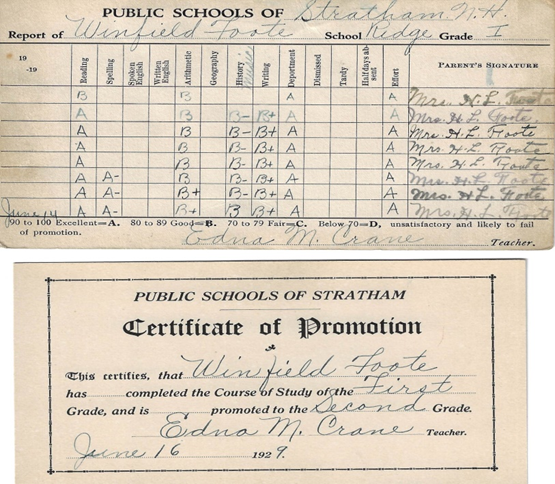
His name, Winfield L. Foote (1922-2004), has been receiving a considerable amount of unexpected publicity over the last 15 years or so even though he died over 20 years ago. He is not known for his As and Bs in first grade, or because Miss Crane catapulted Winfield from first to second grade in 1929 when he was 7 years old. Winfield Foote is celebrated today because of his thoughtfulness and generosity as an adult.
It is said that Winfield arrived in Stratham from Exeter. This is challenging to substantiate. His Ridge School attendance proved that he was already in Stratham when, in 1930, his mother, Leah (Cottrell) Foote bought the old parsonage next to the Christian Church on the Main Road. The property was conveyed by Fred L. Jewell, who was then Trustee of the First Christian Society, “in consideration of one dollar”. Winfield Foote’s father does not appear on the 1930 deed. The church, facing declining attendance, was taken down not long thereafter. Winfield graduated Exeter High School in 1940 and continued to work locally at the Portsmouth Naval Shipyard and in Newmarket all of his working life. Following the passing of both of his parents, Winfield continued to live by himself at 154 Portsmouth Avenue until his own passing in 2004. He became a member of the Stratham Historical Society just two doors away. He would often stop by the Historical Society to strike up a chat with long-term president Barbara Mann.
Winfield Foote’s parents Leah and Harry Foote in front of the house Leah purchased in 1930 “in consideration of one dollar”.
Winfield was an only child and inherited the house where he lived for 74 years. Much to everyone’s surprise, when he passed in 2004, Winfield’s attorney and executor of his will advised that Winfield L. Foote had bequeathed his house and personal property to the Stratham Historical Society. Proceeds from the sale of the house and property now serve in a highly-governed endowment from which 80% of earnings each year go to fund scholarships for high school seniors graduating Exeter High School as well as seniors who live in Stratham graduating from private schools. Scholarships are also available to rising college juniors and seniors from Stratham whose studies are related to history. Grants for advanced students/teachers that align with Stratham Historical Society’s mission for continuing history research are also considered. The Winfield L. Foote Awards for Excellence, as they have been named, live on in perpetuity. Currently, they fund around $15,000 per year in scholarships and grants. Amid the many faces of colonial and later heroes in Stratham who were senators, congressmen, politicians, diplomats, attorneys, judges, doctors, donors, farmers, gardeners, ministers and those who served in the military, Winfield L. Foote is a face of Stratham we should all recognize and revere.
Faces of Stratham are provided by the Stratham Historical Society located at the corner of Portsmouth Avenue and Winnicutt Road. Special thanks to volunteer Jeanne Danilczuk whose research contributed to this article. Our Museum & Library is now open on Tuesdays from 9 am to 11:30 am or by appointment. We hope to expand our open hours in the coming months. Anyone with an interest in Stratham and local history is invited to stop by, become a member, donate or volunteer. We are actively seeking to expand membership and identify those with an interest in volunteering time to advance and share their learning of Stratham history. We can best be contacted by emailing info@strathamhistsoc.org.