
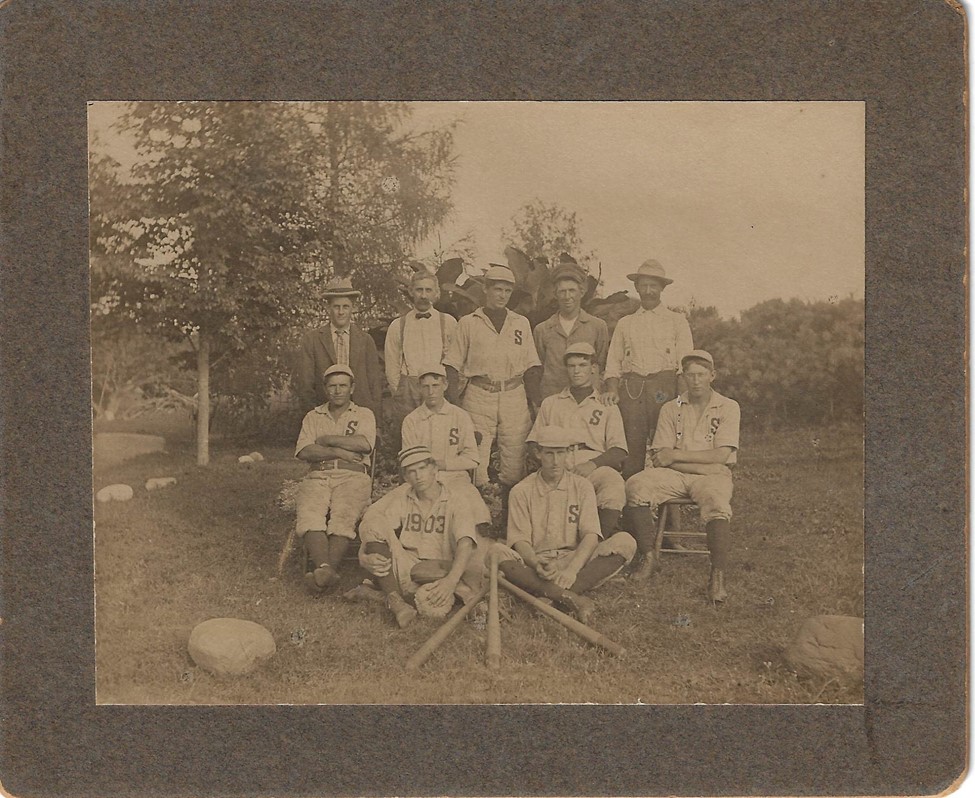
Stratham Baseball Team of 1903
Many know that the roots of modern baseball in America came from the English games of rounders and cricket. There is a popular belief that Abner Doubleday invented baseball in Cooperstown in 1839. Professional baseball arrived when a collection of New York residents, bank tellers and firefighters formed the New York Knickerbockers Baseball Club in 1845. The “Knickerbocker Rules” solidified the diamond shape of the infield, foul lines, the three-strike rule, tagging runners versus throwing the ball at them. The first professional baseball game using these rules was played between the Knickerbockers and a cricket team from Hoboken in 1846. Interest in the game grew rapidly during the Civil War years. Union and Confederate soldiers played the game in camps and prisons and shared interest in the game when they returned to their hometowns following the more serious conflict.
Starting with the 1869 Cincinnati Red Stockings, the National League was launched in 1876. The Boston Red Sox, originally named the Boston Americans, was among the eight charter American League teams formed in 1901. In 1903, the American and National Leagues squared off in the first World Series. No doubt the arrival of professional baseball in Boston and the widespread press gained by the World Series contributed to the interest and founding of the Stratham Men’s Baseball Team that is pictured above. The 1903 team included many well-known Stratham family names: 2 Gowens, 1 Barker, 1 Jewell and 1 Batchelder.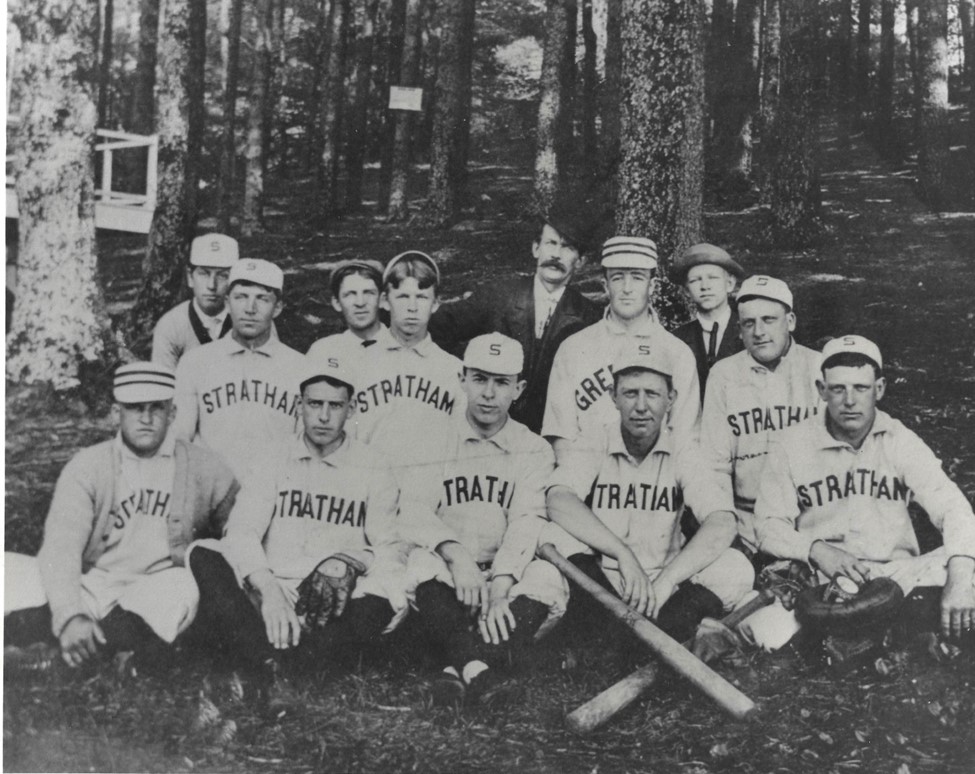
Stratham Baseball Team of 1908
Helen LaFave, in her book Images of America STRATHAM describes the Stratham Men’s Baseball Team of 1908 as the “famous 1908 Stratham baseball team” seen above. Perhaps their fame came from the familiarity of their players: 1 Stockbridge, 1 Tuttle, 3 Gowens, 2 Jewells, 1 Brewster, C.E. Gowen as umpire and P.L. Gowen as scorekeeper.
The Stratham Baseball Team arrived in 1903 and played into the 1960s. Their competition in the Men’s Great Bay League included Eliot, Exeter, Greenland, Hampton, Hedding (a campground in Epping), Kennebunkport, Newmarket and more. Many early baseball team photos only included 9 players in uniform. Interestingly, Stratham’s 1903 team included Eddie Brackett and A.R. Hatch both of Greenland while an early Greenland team photo contains two players in Stratham uniforms. Clearly, teams occasionally borrowed players in order to field a team, but what did Stratham and Greenland do when they had to play each other?
Postcards from Stratham are provided by the Stratham Historical Society. We are grateful to Volunteer Researcher Rick Mahoney who helped unearth original team photos from our collections. The SHS Museum & Library are now open on Tuesdays from 9 am to 11:30 am or by appointment. We hope to expand our open hours in the near future. Anyone with an interest in Stratham and local history is invited to stop by, become a member, donate or volunteer. We are actively seeking to expand membership and identify those with an interest in volunteering time to advance and share their learning of Stratham history. We can best be contacted by emailing info@strathamhistsoc.org.
If you happened to catch the recently aired Ken Burns program about The American Revolution on PBS, you had to be moved by the tragic conflict among friends and neighbors whose loyalties tested their relationships in the years leading up to the war. Believe it or not, well-intended Stratham residents were not immune to the test. Charles Nelson’s History of Stratham 1631-1900 details the pre-Revolutionary War conflict between Deacon Stephen Boardman (1717-1776) and William Pottle, Jr. (1730-1807) that played out in the New-Hampshire GAZETTE AND HISTORICAL CHRONICLE of Portsmouth and became known Charles Nelson and his readers as the Boardman-Pottle Papers.
Firing the first shot in a letter published December 30, 1774, Boardman wrote “Having rode to Portsmouth that day (December 16, 1774) upon Business; when I had entered the Town, I found a Number of Men from other Towns, to the amount of 100, assembled at the East End of the State House. When I was viewing the Company, and enquiring the Reason of their being together; I saw the aforementioned William Pottle, approach the Body on Horse-back; when a Gentleman, from amidst the Crowd, pointing at Mr. Pottle said: “There is a Tory – There is an Enemy to his Country – see how he looks – behold him – how he looks” and many more words of the like Import. To this, Mr. Pottle answered “Why gentlemen, why do you say so?” To which, the Gentlemen before mentioned reply’d – “Sir we know you to be so; we can prove it.”
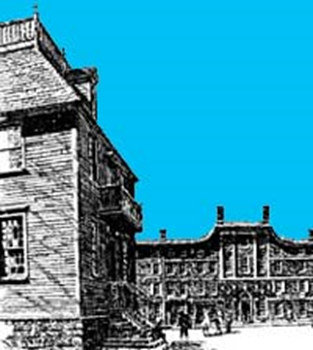
New Hampshire’s first State House was constructed during 1758-1760 on Portsmouth’s Parade (now known as Market Square) just across from where the Athenaeum was later constructed in 1805. Royal Governor John Wentworth gave his oath of office at the Old State House in 1767. George Washington addressed the people of Portsmouth from the Old State House balcony in 1789. A wooden structure, susceptible to Portsmouth fires, NH’s original State House was removed in 1836. A remnant portion of the State House still stands in Strawbery Banke. Cataloged wooden boards are also stored today on a trailer near the Concord capitol.
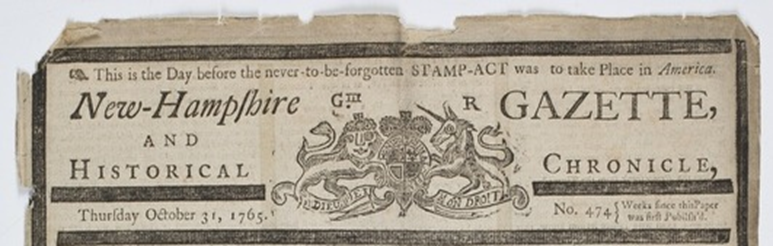
In its day, the New-Hampshire GAZETTE AND HISTORICAL CHRONICLE was the nation’s oldest newspaper. It was founded by former Bostonian printer Daniel Fowle (1715-1787) in Portsmouth and was circulated from 1763 until 1776 or until 1785, depending on the source. Note the 1765 banner comment about the “never-to-be-forgotten STAMP-ACT”. Fowle was not bashful about expressing his opinion. He served time in prison for printing anti-British pamphlets in which he referred to the British as “The Monster of Monsters” and stating that the British were responsible for “A Total Eclipse of Liberty”. Daniel Fowle had no problem sponsoring the debate between Stephen Boardman and William Pottle, Jr. that was contained in four letters published between December 30, 1774 and March 31, 1775.
Stephen Boardman moved to Stratham from Ipswich in the mid-18th century. He lived on Heathy Swamp Road (now High Street) just beyond Barker Road and the Winniconic School. In 1726, Daniel Moody sold 70 acres to William Pottle, Sr. (1705-1785) and his heirs that, according to the deed, included a malt house and malt mill. Today, the frontage of that parcel runs along Portsmouth Avenue from the later to be built Widow Mason House (#181) south past the Colonel Little House (#175) and what became the Greenwood Cemetery and site of the 1840 Baptist Church. Not only were Stephen Boardman and William Pottle, Jr. Stratham neighbors, but they were two of five prominent residents who served together on Stratham’s Select Board in the economically challenging year of 1763. They may or may not have been friends, but as selectmen, you would have to think they knew each other and each other’s thinking and political leanings well.
By trade, William Pottle, Sr. was a blacksmith with abilities he passed along to William Pottle, Jr. Their blacksmith and farrier skills were in demand in a growing agricultural community, and so they had business with many residents of Stratham and neighboring towns. Records show that they had over 200 accounts where items were sold or bartered. Between 1751 and 1767, Boardman was proven to be a regular blacksmith and farrier customer. Pottle investments and labor were visibly supportive of town services. The Pottles also took to the task of growing malt and brew products to produce well-regarded beer and a busy malt house. Their product was so good it was sold in tavern’s including Chace’s (aka Chase’s) Tavern on the Main Road in Stratham and the well- known Stoodley's Tavern in Portsmouth among other popular watering holes that hosted both Loyalists and Patriots. According to historian Charles Nelson, Stephen Boardman “testified publicly that he (William Pottle, Jr.) made good ale, though he urged every Patriot to refuse to drink it because the brewer was a Tory”. The elder Pottle served as a selectman seven times between 1742 and 1770. During William Pottle, Sr.’s 60 some years in town, he acquired 16 properties across Stratham.
Searching for Boardman’s motivation to attack the reputation of William Pottle, Jr. research by B. Craig Stinson, a well-studied Pottle descendant, offers that William Pottle, Jr. was a member of the Stratham Congregational Church where Stephen Boardman and Samuel Lane were both Deacons. In 1766, William Pottle, Jr. lodged a complaint against the then “newly minted Deacon Lane” wherein he asserted that “Deacon Lane was encroaching on the Pottles’ mill privilege , cutting timber and grass, and fencing land that did not belong to Lane. In an open letter to the pastor of the church, Pottle claimed that Deacon Lane was in breach of the Tenth Commandment – presuming of coveting his neighbor’s field – and asked for arbitration. The property matter was referred to a five-member committee of local leaders. Pottle won on all counts and Deacon Lane had to reimburse Pottle for his losses, move the fences and pay the cost of the arbitration.”
Picture a time when anti-British sentiments were already running high in Boston and Portsmouth. The sensitivities of both Patriots and Tories who often lived down the street from each other, worshipped at the same church and drank in the same public houses ran emotionally high. The letters proffered by Stephen Boardman were accusatory and without foundation. His letter published December 30, 1774 continued with Boardman describing others in the State House crowd that shouted at and about William Pottle, Jr. He described a brief physical confrontation from which Pottle rode off. Boardman discussed the supposed opposing views of Pottle and Rev. Joseph Adams of the Stratham Congregational Church.
“William Pottle, Junr.” answered Deacon Boardman’s defamation with a letter of his own published in the New-Hampshire GAZETTE AND HISTORICAL CHRONICLE on January 20, 1775. “Deacon Boardman begins as a Man that would express facts of his own Knowledge only”, Pottle wrote. He then makes his case that Boardman debases his character without needed evidence and asserts that the Deacon’s rantings are “unbecoming a Christian, or even a human Being”. Pottle closes with “And for myself, I stand Ready, if I have injured my country, or any particular Man, to confess it upon a Conviction of my Fault and reform; and as far as I know my own Mind, I am a Friend to my Country; and stand ready to exert my utmost, in every lawful Way, for their Liberty and Freedom.”
The February 17, 1775 New-Hampshire GAZETTE AND HISTORICAL CHRONICLE offers the further response of “Stephen Boardman, one of the Committee of Inspection for the Town of Stratham”. The Committee of Inspection, sometimes known as the Committee of Correspondence or the Committee of Safety was formed in late 1774 in many New Hampshire towns to observe the conduct of all persons and to ensure compliance with the Patriot cause. Committee of Inspection member Boardman penned that “agreeable to the eleventh article of the Continental Association, it is the Duty, not only of the Committee of inspection, but of every Individual, to have such a Man’s Conduct known to the World; in order to render him contemptible; and prevent everyone from having Dealings with him, tho’ it be the destruction of him and his Family”. Among other items, Boardman argues that Pottle “opposed and endeavored to prevent the Vote of the Town for suppressing the Use of East India tea – that he freely drank it himself ever since, as often as he could obtain it; and has lately complained that his Merchant’s Tea was all gone; and he could not get any more”.
The last word in the Boardman-Pottle exchange was printed in the March 31, 1775 of the New-Hampshire GAZETTE AND HISTORICAL CHRONICLE just weeks ahead of the Battles of Lexington and Concord. In a lengthy defense, “William Pottle, jun.” closed with “Had I any Reason from any Part of Boardman’s Conduct to think he paid any real Regard to the Writings of the Wisest Men, I would recommend to his serious Consideration; that it is an Honour for a Man to cease from Strife, but that every Fool will be meddling”.
More to come on the demonstrated politics of William Pottle, Sr. and Jr. in the months to come when “Postcards from Stratham” addresses the Association Test.
Asking forgiveness for the length and frequent historical wanderings of this Postcard, I remind you that the intent was to highlight the extraordinary feelings of neighbors and countrymen leading up to the Revolutionary War. In many if not most cases, opposing political viewpoints were perilously adopted by residents who were born in America. While a Stratham controversy is featured, know that it is representative of heightened emotions that were felt throughout the colonies. And know that the drafting of this Postcard was motivated by similar depictions contained in Ken Burns’ most recent film, “The American Revolution”. If you haven’t seen it, …
Postcards from Stratham are provided by the Stratham Historical Society. This month we express our gratitude to B. Craig Stinson who is a lifetime member of SHS and a descendant of William Pottle, Sr. and Jr. for his review of this Postcard and the sharing of his own research that has been quoted in this article. The SHS Museum & Library is now open on Tuesdays from 9 am to 11:30 am or by appointment. We hope to expand our open hours in the near future. Anyone with an interest in Stratham and local history is invited to stop by, become a member, donate or volunteer. We are actively seeking to expand membership and identify those with an interest in volunteering time to advance and share their learning of Stratham history. We can best be contacted by emailing info@strathamhistsoc.org.
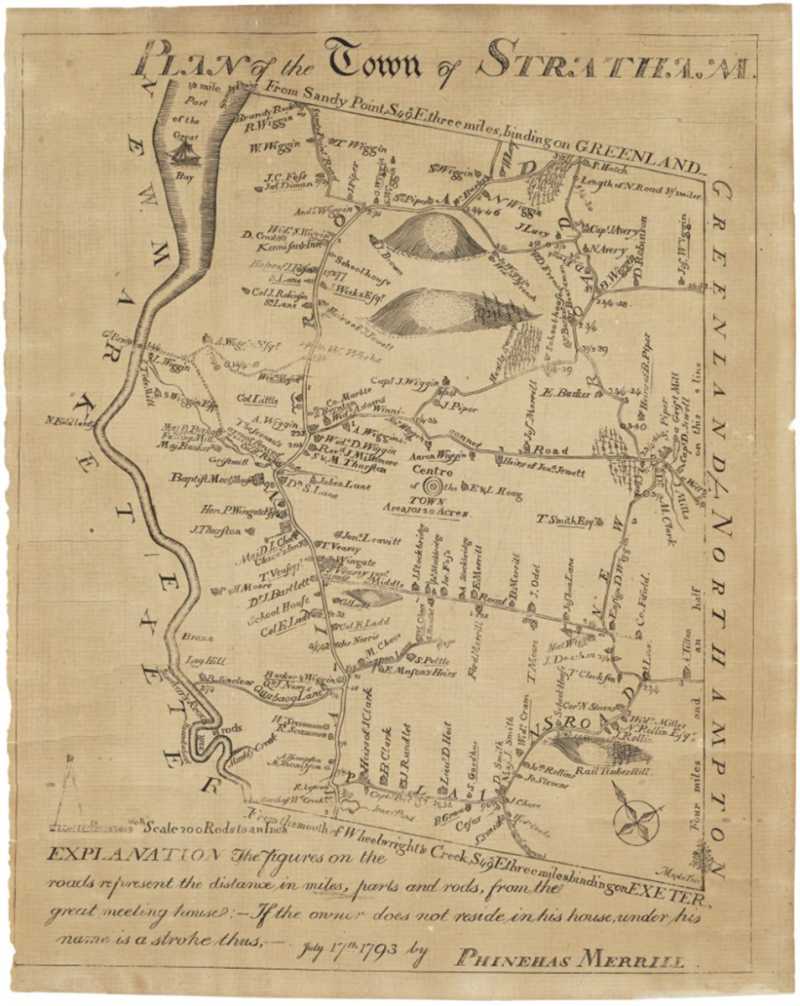
One of the most valuable research tools on the history of Stratham is a hand-colored engraving by Phinehas Merrill (1767-1815) made available in July of 1793. Merrill completed a similar Plan for the Town of Exeter in 1802 and one for Portsmouth in 1805. The Stratham native updated his hometown map in 1806. The research value comes not just in the layout of the streets but in identifying the name and location of each homeowner of the day and an effort to finely draw the architectural style and scale of each house. Some 150 dwellings are represented. Homeowners who did not occupy their designated homes in 1793 had their names underlined. You might recognize many early colonial names associated with Stratham including Wiggin, Hon. Paine Wingate, Deacon Samuel and other Lanes, Barker, Brewster, Chace, Clark, Foss, Jewell, Little, Merrill, Piper, Pottle, Rollins, Stockbridge, Thurston and Veasey among others. If you look closely, you can also hunt down four 18th century one-room schoolhouses and the then existing Baptist and Congregational Churches (both alternately titled meetinghouses). The siting of early mill buildings is also depicted.
All of this detail is even more impressive when it becomes known that the original engravings of the Plan of the Town of Stratham measured just 7.375” x 9.375”. Seven original engravings are known to exist at the New Hampshire Historical Society, Massachusetts Historical Society, the Library of Congress, University of Maine Orono, the Osher Map Library, Dartmouth College and the Clements Library. The Stratham Historical Society believes it has two original engravings displayed on its walls. One such map residing in the museum area of SHS has been enlarged to 39” x 45” and is ideal for those who mean to truly and accurately study Stratham’s history. If you don’t have time to study in the SHS area reserved for Stratham artifacts, 1793 maps enlarged to 17” x 22” are available to the public for purchase for only $5. A fully laminated version is only $7.
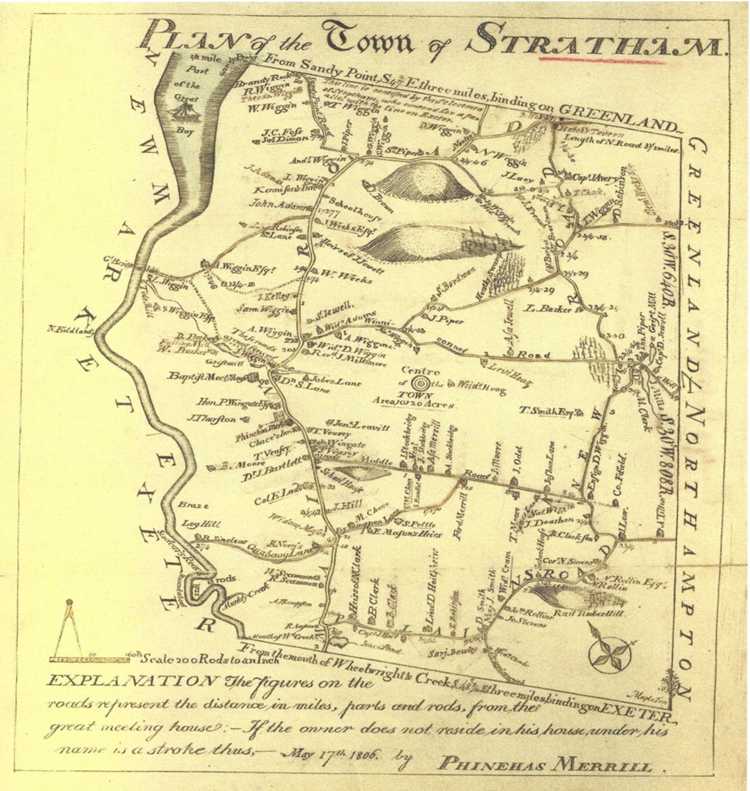
The 1806 version of Phinehas Merrill’s map captures 56 or more alterations to the 1793 map involving typical property transfers including his own acquisition of Major Dudley L. Chace’s house near the Congregational Church (and Meetinghouse) on what is now known as Emery Lane.
Phinehas Merrill grew up on Bunker Hill Avenue in the 18th century when it was known as Middle Road. He was known to be a teacher, mathematician, author, penman, civil engineer and surveyor. He additionally served our community as Town Clerk from 1799-1807 and Selectman in 1807. We very much continue to value his contributions to this day.
Postcards from Stratham are provided by the Stratham Historical Society. Our Museum & Library is now open on Tuesdays from 9 am to 11:30 am or by appointment. We hope to expand our open hours in the near future. Anyone with an interest in Stratham and local history is invited to stop by, become a member, donate or volunteer. We are actively seeking to expand membership and identify those with an interest in volunteering time to advance and share their learning of Stratham history.
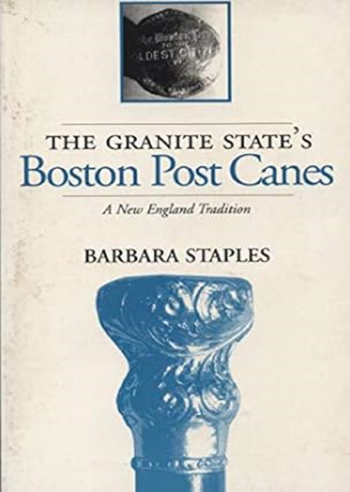 The Stratham Historical Society is now looking for the oldest citizen of Stratham. Rich in tradition, the original Boston Post Cane is on permanent display at the Stratham Historical Society. Its symbolic replica and certificate are given over to Stratham’s oldest citizen to maintain. Many familiar Stratham family names have been keepers of the cane: 3 Jewell family members, Thompson, Barker, Cote, Lane, Foote Wentworth, Emery, Chase, Parkman, Breslin, Dolloff and most recently, Dottie Clemons of River Road, who held the cane at the age of 105.
Here is the backstory on the Boston Post Cane. On August 2, 1909, Edwin Atkins Grozier, Editor and Publisher of the Boston Post newspaper, sent letters and canes to the Board Chairs of the Select Boards of towns with a population exceeding 500 in most New England States. The letter asked the Select Boards to become trustees of the canes made by J.F. Bradley and Company of New York. The canes were then described as made from “carefully selected Gaboon ebony from the Congo, Africa” with the head made of “rolled gold of 14 carat fineness”.
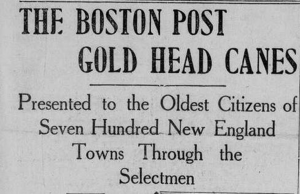
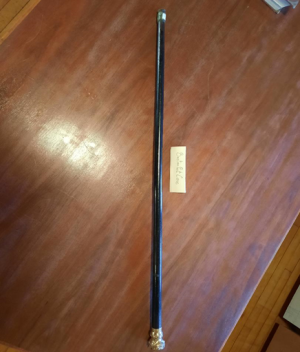 The letter accompanying the cane to 700 towns stipulated that the cane was to be presented to the oldest citizen of the town and subsequently passed along to the next oldest citizen. The publicity tactic was not without controversy. A following letter clarified that the cane was to be presented to the “oldest male citizen of the town who was a voter”. In 1923, a Massachusetts town awarded the cane to a woman for the first time. In the following decade, the Boston Post granted permission for all towns to award the cane to qualified women as well as men. Stratham’s first female recipient was 96 year-old Hannah M. Barker in 1938.
As one can imagine, many Boston Post Canes have been misplaced over the years. Thankfully, many towns maintain the tradition in the same manner as Stratham. Over 400 towns were still handing out the cane in 1987 even though the Boston Post published its last newspaper in 1956. Many of those towns were and are known to hold the original 1909 cane in a secure place while the Select Board recognizes each successive awardee with a ceremony, a certificate and a handsome reproduction. Stratham’s Boston Post Cane was missing for a while, but the original can now be visited during open hours at the Stratham Historical Society.
This is a community tradition, and you can help! If you know someone, male or female, who is at least 92 years old and a citizen of Stratham, please reply to this Postcard (email) with a name and contact information.